


 ไทย
ไทย
HUMAN RIGHTS
Human Rights Policy and Practices
The Company is committed to conducting its business with integrity and upholding its responsibilities to society and all stakeholder groups in accordance with good corporate governance principles and the Company’s Code of Conduct. With regard to human rights protection, the Company complies with applicable laws and internationally recognised human rights principles to ensure that its business operations are free from human rights violations, both in the Company’s direct activities and throughout its business relationships across the value chain, including business partners in the business value chain and joint ventures.
The Company has established its Human Rights Policy based on internationally recognised human rights principles and practices, including the Universal Declaration of Human Rights (UDHR), the International Labour Organization (ILO) Declaration on Fundamental Principles and Rights at Work, and the United Nations Guiding Principles on Business and Human Rights (UNGPs).
Salient Human Rights Issues Relevant to Business Operations
The Company recognises that the nature and context of different types of business operations may give rise to different human rights risks and impacts. The Company therefore places importance on identifying and assessing human rights issues that are relevant and significant to its business operations, covering both the Company’s own operations and relevant parties throughout its value chain.
The human rights issues prioritised by the Company include:
- Labour rights and fair employment conditions, including non-discrimination and equal opportunities.
- Occupational health and safety for employees, contractors, and persons involved in the Company’s operations.
- Customer and service user rights and safety, including residents and users of properties and facilities under the Company’s management.
- Community rights and the safety of communities surrounding operational areas, particularly areas associated with construction projects and the Company’s operations.
- Labour rights in the supply chain, including the prevention of child labour and forced labour, and the protection of workers’ health and safety.
- Right to privacy and personal data protection of employees, customers, service users, and relevant stakeholders.
Stakeholder Engagement in Identifying Human Rights Issues
The Company is committed to listening to and providing opportunities for relevant stakeholders to participate in the identification and assessment of human rights issues that may arise from its business operations. Stakeholders include employees, customers, service users, contractors, suppliers, communities, and relevant authorities, through communication and engagement channels appropriate to each stakeholder group.
Feedback, complaints, and information received from stakeholders are taken into consideration in assessing human rights risks and impacts to identify salient issues, establish measures to prevent and mitigate impacts, and continuously improve the Company’s human rights management practices.
Human Rights Practices
The Company places importance on respecting human rights across all of its activities. All directors, executives, and employees are expected to jointly promote organisational values and a corporate culture that respects human rights and to adhere to the following principles:
- Treat all individuals equally and fairly in accordance with human rights principles and based on respect for human dignity, without discrimination or distinction based on origin, race, nationality, gender, age, skin colour, religion, opinions or expressions, physical condition, socioeconomic status, family background, or any other differences.
- Conduct business activities without directly or indirectly contributing to human rights violations against relevant persons.
- Support and respect the protection of human rights, ensure that the Company’s business does not contribute to human rights violations, and protect the human rights of employees and stakeholders, including customers, employees, business partners, and vulnerable groups.
- Communicate and promote understanding among relevant parties throughout the value chain regarding the Company’s human rights principles and practices.
- Regularly monitor, review, and assess human rights risks and impacts, and establish appropriate risk management measures and mitigation approaches.
- Establish effective grievance management and information management processes, and continuously develop channels for complaints and reporting of human rights violations.
- Support stakeholder participation and strengthen the capacity of communities and society to promote better quality of life.
- Promote activities that generate long-term benefits for society, communities, and the environment in alignment with the Company’s business operations.
- Support environmental conservation and restoration to promote ecological balance.
Human Rights Governance Structure and Responsibilities
The Company has established clear roles and responsibilities for human rights management to ensure that its business is conducted with integrity and in accordance with its responsibilities to society and all stakeholder groups under good corporate governance principles and the Company’s Code of Conduct, as follows:
1) Board of Directors
Responsible for establishing policies and overseeing measures to prevent human rights violations across all of the Company’s business activities and throughout its value chain.
2) Corporate Governance and Sustainability Committee
Responsible for overseeing and monitoring the Human Rights Due Diligence (HRDD) process to ensure alignment with the Company’s Human Rights Policy and for reviewing the Human Rights Policy annually.
3) Chief Executive Officer and Management
Responsible for establishing a clear organisational structure and assigning appropriate responsibilities to drive and oversee the effective implementation of the Human Rights Policy.
4) Human Rights Working Group
Responsible for implementing the HRDD process in practice, with key responsibilities including:
- Integrating human rights principles into business policies and relationships with suppliers.
- Assessing human rights risks and impacts by taking stakeholder feedback into consideration.
- Establishing preventive measures and corrective approaches to reduce risks and impacts both within and outside the organisation.
- Establishing appropriate remedial measures for persons affected by human rights impacts.
- Communicating human rights impact assessment results, remedial measures, approaches to managing impacts, and performance results to affected persons and the public, as appropriate.
- Engaging with relevant stakeholders, including affected groups, human rights experts, and civil society organisations.
- Providing channels for reporting concerns and seeking remedy for persons affected by human rights and labour-related impacts.
- Collecting and maintaining records and reports on human rights impact assessments and labour practices.
- Reporting human rights and labour practice performance to the Corporate Governance and Sustainability Committee at least once a year.
5) All Employees
Responsible for complying with the Human Rights Policy and reporting concerns if they become aware of any actions that are inconsistent with human rights protection principles.
Whistleblowing, Grievance Mechanism, and Whistleblower Protection
The Company provides channels for stakeholders to submit whistleblowing reports and complaints, with such channels publicly available on the Company’s website. These channels enable stakeholders to raise concerns or submit complaints regarding human rights violations or practices that are inconsistent with the Company’s policies and practices.
Whistleblowers and complainants are provided with protection, and relevant information is kept confidential. The Company will not take any retaliatory action or otherwise adversely affect the rights or employment status of whistleblowers or complainants during or after the investigation process. Disclosure of information will be made only where necessary and in accordance with applicable laws or relevant procedures.

Human Rights Due Diligence
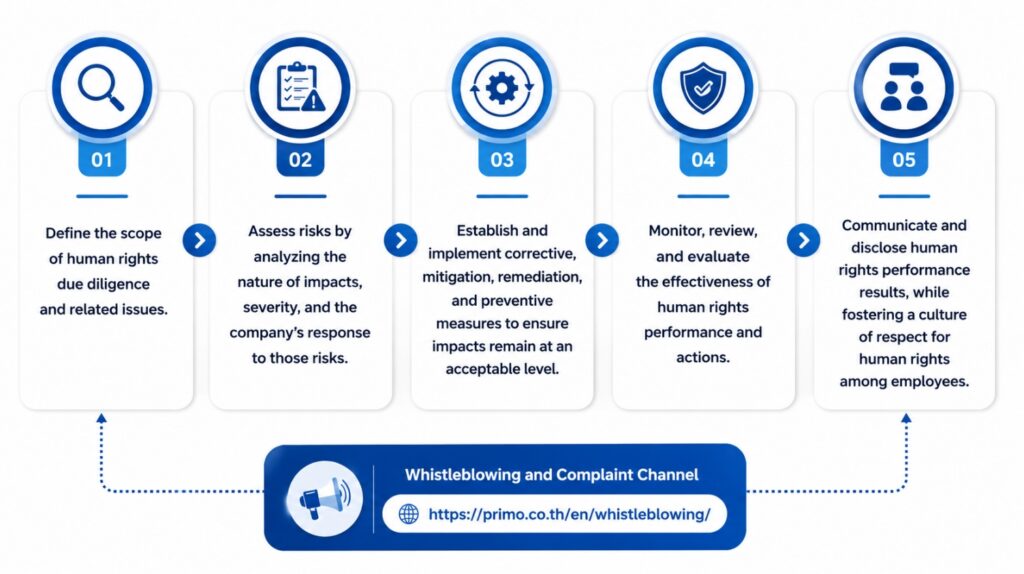
The Company conducts Human Rights Due Diligence (HRDD) every three years in accordance with the United Nations Guiding Principles on Business and Human Rights (UNGPs) to identify and assess human rights risks and impacts arising from its business operations, both within the organisation and throughout its value chain. The process takes into consideration the views of stakeholders and potentially affected persons to establish measures to prevent and mitigate adverse impacts, including appropriate remedial measures, as well as to continuously monitor and review the Company’s performance. In addition, the Company integrates human rights principles into its policies and business operations, including its relationships with business partners, to promote effective human rights management throughout the value chain.
Human Rights Risk Assessment Across the Value Chain
Value Chain | Key Human Rights Risks | Risk Management Approaches |
1. Customer acquisition and marketing, advertising, and contract execution | • Misleading communication or exaggerated information that may affect decision-making • Violation of personal data privacy, including collecting or using data without consent • Limited access to services where communication channels do not accommodate vulnerable groups, such as persons with disabilities | • Comply with the PDPA and develop effective data management systems, while training employees to communicate transparently and responsibly. • Improve websites or applications in accordance with WCAG standards to ensure accessibility for all groups. |
2. Procurement and supplier selection | • Forced labor or child labor risks within suppliers’ supply chains • Unfair working conditions, including suppliers failing to pay wages in accordance with standards or providing unsafe working environments | • Establish a responsible procurement policy and a Supplier Code of Conduct covering human rights issues, requiring all suppliers to acknowledge and comply. • Conduct regular supplier assessments, including both self-assessments and on-site audits. |
3. Human resource development, employee recruitment, and training | • Workplace discrimination in recruitment, promotion, or benefits due to biases related to gender, race, age, disability, etc.• Workplace harassment and intimidation• Violation of the right to freedom of association and collective bargaining• Inadequate training, including insufficient awareness of human rights and employees’ responsibilities regarding such rights | • Establish a human rights policy and regularly review and update human resource policies to align with principles of non-discrimination and diversity.• Provide safe and transparent internal grievance channels that protect whistleblowers.• Provide training on human rights, non-discrimination, and prevention of workplace harassment for employees at all levels. • Respect employees’ rights to peacefully form associations. |
4. Delivery of products and services | • Employee health and safety risks, particularly when working off-site at client locations | • Develop a Customer Due Diligence framework to assess human rights risks before accepting engagements. • Establish safety plans for employees who are required to work off-site. |
5. After-sales services | • Violation of privacy rights, including misuse of data obtained through after-sales services• Failure to adequately address customer complaints | • Train employees to recognize privacy rights and implement measures to address misuse of after-sales data. • Establish a complaint management policy with fair processes aimed at resolving issues effectively. • Monitor and analyze the root causes of complaints to improve services and reduce the risk of recurrence. |
Human Rights Risk Mitigation and Prevention Mechanisms
The Company has established measures to prevent and mitigate human rights risks, with the aim of preventing and reducing the likelihood of adverse impacts on stakeholders, as well as minimising the severity of such impacts to an appropriate level. These measures cover the Company’s operations and its relationships with suppliers, contractors, business partners, and relevant stakeholders throughout the value chain.
Internal Measures
The Company implements internal measures through its Human Rights Policy and Practices, Business Code of Conduct, personal data protection measures, employee communication and awareness-raising activities, regular assessment and monitoring of human rights risks, as well as clearly defined roles and responsibilities of relevant functions. These measures are intended to ensure that the prevention and management of human rights issues are systematically integrated into the Company’s business operations.
External Measures and Value Chain Management
The Company encourages suppliers, contractors, and business partners to conduct their operations in compliance with applicable laws, the Company’s requirements, and relevant human rights principles. Human rights considerations are incorporated into the assessment and management of relationships with business partners, together with monitoring of potential risks arising from business activities and business relationships throughout the value chain.
The Company places importance on listening to the views of stakeholders and potentially affected persons. Information, feedback, and concerns received from stakeholders are taken into consideration when identifying, assessing, and managing human rights risks, as well as when establishing appropriate measures to prevent and mitigate impacts based on the context and nature of each issue.
The Company continuously monitors its performance and reviews the effectiveness of the measures implemented to assess the appropriateness of its risk management approach. The results of such monitoring and review are used to further improve measures for preventing and mitigating human rights impacts and to enhance the effectiveness of the Company’s human rights management.
Grievance Mechanisms and Stakeholder Engagement
The Company provides diverse, accessible, and confidential channels for submitting complaints and whistleblowing reports, enabling stakeholders to safely raise concerns, submit complaints, or report issues that may be related to human rights violations. The channels provided by the Company include:
-
Online Grievance Reporting Centre: An online complaint-handling system available through the Company’s website, enabling stakeholders to submit complaints 24 hours a day. The system supports multiple languages and allows reports to be submitted anonymously.
-
Call Center: A channel for receiving complaints and concerns from stakeholders. Relevant personnel are specially trained in complaint handling and data confidentiality, with an established process for referring complaints to the responsible function for further action in accordance with the prescribed procedures.
-
Dedicated E-mail: A dedicated e-mail channel for submitting complaints or whistleblowing reports. Reports received through this channel are directly referred to the relevant management or responsible function to facilitate appropriate and timely consideration and action, particularly for sensitive matters.
-
Confidential Suggestion Box: Confidential suggestion boxes are provided in appropriate and private areas within the Company’s offices, allowing individuals who may not be comfortable using digital channels to submit comments or raise concerns.
-
Direct Engagement and Consultation: The Company conducts communication and direct engagement with communities and relevant stakeholders, as appropriate, to listen to their concerns, views, and recommendations. Information obtained through such engagement is taken into consideration in reviewing and improving the Company’s human rights management approach.
The Company places strong emphasis on maintaining the confidentiality of information and protecting complainants and whistleblowers from retaliation or unfair treatment. Complaints and information received are reviewed and addressed in accordance with the Company’s established procedures, with due consideration given to appropriateness, fairness, and the confidentiality of relevant parties.
Grievance Management Process
Upon receiving a complaint or whistleblowing report, the Company follows an established process in a systematic, transparent, and fair manner, while ensuring the confidentiality of information and the protection of complainants. The key steps are as follows:
1. Complaint Receipt and Acknowledgement
Complaints and whistleblowing reports received through the channels designated by the Company are recorded and registered in the relevant system to enable systematic tracking of their status and outcomes. The Company provides an acknowledgement of receipt to the complainant within 24 hours.
2. Screening and Severity Assessment
The designated function or working group conducts an initial screening of the information received and assesses the nature and severity of the complaint, including its urgency and potential impacts, in order to determine the appropriate priority and course of action.
3. Fact-Finding and Investigation
The Company assigns appropriate individuals or an investigation committee with relevant expertise based on the nature of the complaint to comprehensively gather and review relevant information and evidence. Investigations are conducted objectively and fairly, without undue interference or conflicts of interest.
4. Review and Determination of Corrective and Remedial Measures
Management or the committee responsible for corporate governance and sustainability reviews the findings of the assessment and investigation together with the relevant functions to determine appropriate corrective and remedial measures. These measures may include actions to address the identified impacts, prevent recurrence, and provide appropriate remedy, with due consideration given to human rights principles, fairness, and the rights of all relevant parties.
5. Communication of Outcomes
The Company communicates the outcome of the review and relevant actions or measures to the complainant, as appropriate, while taking into consideration confidentiality and personal data protection requirements. Where appropriate, complainants are provided with an opportunity to provide comments or additional information regarding the proposed resolution.
6. Follow-up and Effectiveness Review
The Company follows up on the implementation of corrective and remedial measures and reviews the appropriateness and effectiveness of the grievance management process. Lessons learned and information obtained from the process are used to continuously improve preventive measures, management systems, and grievance-handling procedures.
The Company places strong emphasis on maintaining the confidentiality of information and protecting complainants, whistleblowers, and relevant persons from retaliation, threats, or unfair treatment. Access to complaint-related information is restricted to authorised persons with relevant responsibilities on a need-to-know basis, and information is disclosed only as necessary and in accordance with applicable laws and relevant regulations.
Comprehensive Remediation Measures
The Company places importance on appropriately and fairly addressing and providing remedy for human rights impacts, in a manner consistent with the nature and severity of the impacts identified. Where the Company identifies that its operations or business relationships have caused or contributed to human rights impacts, the Company considers and implements appropriate corrective and remedial measures, taking into account the rights, needs, and circumstances of affected persons. The remediation measures cover the following key approaches:
1. Restoration and Support for Affected Persons
The Company considers appropriate approaches to restore and support affected persons, with the aim of helping them return to an appropriate condition based on the context of the incident and nature of the impacts. Such measures may include support for quality of life, restoration of the environment or living conditions, and appropriate assistance or guidance based on identified needs.
2. Corrective Actions and Prevention of Recurrence
The Company addresses the root causes of identified issues and reviews relevant measures. Where appropriate, the Company may improve policies, operating procedures, internal control systems, or monitoring mechanisms to prevent or reduce the likelihood of similar human rights impacts occurring in the future.
3. Accountability and Communication
The Company places importance on appropriate communication with affected persons and relevant stakeholders. The Company considers appropriate approaches to demonstrate accountability for identified impacts and communicates relevant corrective actions and preventive measures to be implemented. Any disclosure of information takes into consideration confidentiality requirements, personal data protection, and the rights of relevant parties.
4. Participation of Affected Persons
The Company provides opportunities for affected persons and relevant stakeholders to participate, as appropriate, in considering corrective and remedial measures. This is intended to ensure that the measures established appropriately reflect the circumstances, needs, and actual impacts experienced by affected persons.
5. Follow-up and Evaluation of Remediation Effectiveness
The Company follows up on the implementation of corrective and remedial measures and continuously evaluates their effectiveness to ensure that identified impacts are appropriately addressed and that the measures implemented can reduce risks and prevent recurrence. The results of monitoring and lessons learned are used to continuously improve the Company’s human rights management processes.
The Company is committed to ensuring that its remediation processes are fair, transparent, and respectful of the rights of affected persons. Such processes are implemented based on human rights principles and the Human Rights Due Diligence (HRDD) approach to support the effective prevention, mitigation, correction, and remediation of human rights impacts.
Monitoring and Review of Human Rights Risks
The Company has implemented a systematic process for monitoring and evaluating its human rights performance. The Human Rights Working Committee convenes on a monthly basis, and progress is reported to the Executive Committee on a quarterly basis. An annual report is also prepared and publicly disclosed. In addition, the Company reviews and updates its human rights policies and practices annually to ensure alignment with evolving circumstances and emerging international standards.
The Company monitors human rights risks through regular risk assessments, grievance mechanisms, and feedback received from stakeholders. It also oversees the performance of relevant departments and functions to ensure effective implementation of human rights commitments. The results of these monitoring activities are reported to the Executive Committee on a quarterly basis. Furthermore, related management measures and policies are reviewed at least annually to ensure their continued effectiveness and relevance.
Impact Management
Although the Company has not encountered any cases of human rights violations to date, it has established preparedness measures to manage potential impacts. Clear remediation and mitigation plans have been developed, with contingency budgets allocated for such actions, and responsible persons designated at each level to address potential issues.
Future Action Plan
The Company remains committed to continuously strengthening its human rights performance. Future action plans include enhancing operational standards across the entire value chain, improving monitoring and verification systems, and fostering collaboration with business partners to promote respect for human rights throughout the supply chain.
The Company will continue to provide training and capacity-building programs for employees and business partners to raise awareness and understanding of human rights issues. In addition, technology and innovation will be leveraged to support risk management and performance monitoring, ensuring that the Company’s operations align with international standards and effectively meet stakeholder expectations.
For Business Partners: Primo Service Solutions Public Company Limited places great importance on conducting business in accordance with human rights principles and fair labor practices. The Company has established guidelines requiring all relevant stakeholders to comply with standards related to labor rights, the prevention of child labor and forced labor, as well as the promotion of a safe, fair, and respectful working environment that upholds human dignity through its Supplier Code of Conduct.
In addition, the Company promotes awareness and understanding of human rights among employees and business partners to support operations in alignment with internationally recognized standards and best practices.
For Communities: Primo Service Solutions Public Company Limited is committed to fostering positive relationships with surrounding communities and society through activities and initiatives that support quality of life improvement, create career opportunities, and promote sustainable development. The Company also takes into consideration the impacts of its operations on communities, the environment, and stakeholders across all sectors.
Furthermore, the Company places importance on designing and developing services that are equally accessible to everyone, including the elderly and persons with disabilities. This supports convenient and safe access to services and facilities while helping reduce inequality in access to the Company’s services.
Personal Data Protection and Cybersecurity
Primo Service Solutions Public Company Limited places great importance on protecting the personal data of customers, business partners, employees, and stakeholders. The Company has implemented information security measures to prevent unauthorized access, use, or disclosure of data in compliance with the Personal Data Protection Act (PDPA).
The Company also promotes employee awareness of data security and cybersecurity while providing transparent channels for reporting data protection incidents or concerns.


Good Corporate Governance
Primo Service Solutions Public Company Limited is committed to conducting business with good governance and transparency. The Company has established a Human Rights and Sustainability Committee to oversee, monitor, and review human rights practices across all organizational processes. The Committee is responsible for considering preventive and corrective measures related to human rights issues and reporting performance results to the Executive Committee.
Human Rights Grievance Mechanism
Primo Service Solutions Public Company Limited has established complaint and whistleblowing channels for employees, customers, business partners, and related stakeholders. The Company ensures that all processes are handled confidentially, fairly, and effectively, while providing protection against retaliation in any form. Complaint handling results are also regularly reported to the Audit Committee.

Key Activities and Projects
Primo Service Solutions Public Company Limited organized the “Primo Pride 2025: How You Pride” activity to celebrate Pride Month and promote equality under the concept of respecting diversity and embracing individuality. The event featured creative activities, including tote bag painting and encouragement-sharing activities for residents and surrounding communities, fostering happiness, participation, and equal acceptance of diversity in society.