




 ไทย
ไทยCLIMATE CHANGE MANAGEMENT
Greenhouse Gas Management
With its mission to be a leader in providing comprehensive and sustainable real estate services, the Company recognizes the importance of climate change and supports Thailand’s and the Thai capital market’s efforts to reduce greenhouse gas emissions and transition toward a low-carbon economy. The Company places importance on the role of the business sector in supporting climate change action and has participated in the JUMP+ (Jump Plus) Program organized by the Stock Exchange of Thailand (SET), which encourages listed companies to develop Climate Action Plans and establish systematic greenhouse gas emissions reduction targets. In this regard, the Company has incorporated these approaches into the development of its greenhouse gas emissions reduction targets and measures, covering Scope 1, Scope 2, and Scope 3, to support the transition toward business operations with continuously reduced greenhouse gas emissions.
The Company also places importance on adapting to and preparing for the impacts of climate change, as well as mitigating various risks that may cause short- and long-term adverse impacts on the Company. The Company considers both physical risks, such as floods, droughts, and storms, which may cause damage to assets and disrupt business operations through supply chain disruptions or affect the health and safety of stakeholders, as well as transition risks arising from changes in laws, regulations, and government policies related to climate change that may become increasingly stringent. Accordingly, the Company has established a Climate Change Management Policy covering all aspects of its business operations, implemented measures to assess and manage natural disaster risks, and integrated climate-related risks and opportunities into its business strategy.
Net Zero Emissions Target
Covering Scope 1,2 and 3
50%
Greenhouse Gas Emissions Reduction
2035
Carbon Neutrality
2044
Net Zero
2050
The Company has set a Goal to achieve Net Zero greenhouse gas (GHG) emissions by 2050 (B.E. 2593) and Carbon Neutrality by 2044 (B.E. 2587). To achieve these GHG reduction Goals, the Company has established implementation guidelines, measurable Goals, key performance indicators (KPIs), and risk and impact assessments. The Company also conducts an annual review of its Goals and performance to ensure alignment with current circumstances and evolving climate-related developments.
Management Approach
The Company recognizes the significance of climate change and its potential direct and indirect impacts on business operations. Accordingly, the Company is committed to developing strategies aligned with ESG principles and government policies to strengthen long-term sustainability and competitiveness.
Roles and responsibilities related to climate change oversight have been clearly defined at both Board and management levels.
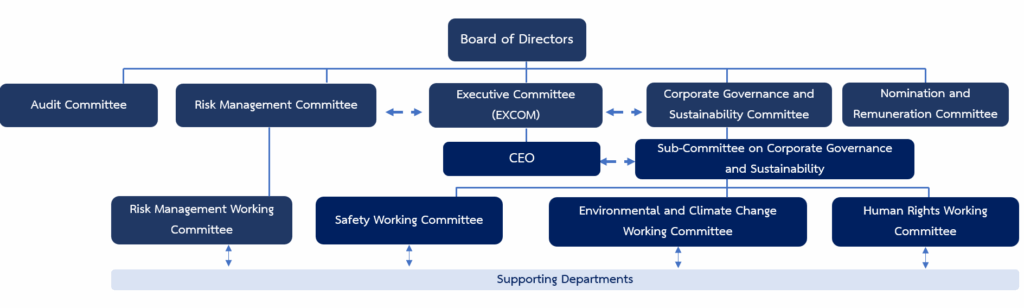
The Executive Committee has incorporated climate change into the organization’s environmental objectives and established an Environmental and Climate Change Working Committee, chaired by a senior executive. This committee is responsible for overseeing and implementing climate-related initiatives under the following management framework:
- Assess climate-related risks to establish preventive and adaptive measures.
- Monitor the organization’s carbon footprint and implement GHG reduction measures.
- Improve energy efficiency and promote the use of clean energy.
- Enhance energy and resource efficiency, reduce energy consumption, and select environmentally friendly materials in business operations.
- Manage resources and waste effectively to reduce GHG emissions.
- Promote collaboration and stakeholder engagement (e.g., employees and residents) to raise awareness of climate change.
Roles and Responsibilities of the Board and Executives Related to Climate Change
Board of Directors
Role: The highest approving authority and the body accountable for the Company’s sustainability.
Responsibilities: Establish the direction, strategies, and approve policies related to climate change.
- Approve long-term targets, such as achieving Carbon Neutrality or Net Zero.
- Oversee the integration of climate-related risk management into the Company’s business strategy.
Corporate Governance and Sustainability Committee
Role: Review and oversee policies at the governance level.
Responsibilities: Review greenhouse gas reduction plans and targets prior to proposing them to the Board of Directors.
- Monitor progress against environmental Key Performance Indicators (KPIs) on a quarterly basis.
- Provide recommendations on new laws and international standards, such as the Climate Change Act B.E. 2568 (2025).
Corporate Governance and Sustainability Subcommittee
Role: Drive the implementation of strategies and review relevant information.
Responsibilities: Analyze climate-related risks and opportunities in line with the Task Force on Climate-related Financial Disclosures (TCFD) framework and propose them to the Board.
- Review the accuracy of sustainability reports and carbon emissions data.
- Coordinate between the policy and operational levels to ensure organization-wide integration.
Chief Executive Officer (CEO) and Senior Executives
Role: Lead transformation and manage organizational resources.
Responsibilities: Drive the implementation of policies across all business units.
- Allocate resources, budgets, and technologies necessary to support carbon reduction initiatives.
- Communicate the importance of climate action and foster a climate-conscious organizational culture.
Environmental and Climate Change Working Committee
Role: Operational implementation and technical data management.
Responsibilities: Collect and calculate the Company’s Corporate Carbon Footprint (CCF) data annually.
- Propose initiatives to reduce energy consumption and improve waste management within buildings and offices.
- Prepare performance reports for submission to the Subcommittee.
Climate change management is one of the Company’s sustainability KPIs, which apply to the CEO, senior executives, and relevant employees responsible for sustainability indicators, including greenhouse gas emissions reduction, water usage, and sustainability assessments.
Climate change management is incorporated into the Company’s sustainability KPIs and applies to the CEO, senior executives, and relevant employees. These KPIs include GHG emission reduction, water consumption efficiency, and sustainability performance assessments.
The Corporate Governance and Sustainability Committee is responsible for setting GHG reduction Goals and action plans, and for monitoring performance reported by the Environmental and Climate Change Working Committee on a quarterly basis. This ensures effective control of GHG reduction performance and continuous improvement of climate-related strategies.
Climate Change Scenario Analysis
The Company conducts Climate Change Scenario Analysis to assess the resilience of its strategies and business operations under different climate change scenarios, as well as to identify potential risks and opportunities arising from both physical changes in the climate (Physical Risks) and the transition towards a low-carbon economy (Transition Risks).
The results of the analysis are used to support risk management, strategic planning, the development of the Climate Change Adaptation Plan and Climate Transition Plan, and the consideration of measures to strengthen the Company’s adaptive capacity and long-term business resilience.
The Company considers climate change scenarios across the short, medium, and long term, taking into account potential impacts on its operations, assets, employees, customers/service users, supply chain, costs, and business continuity.
The analysis applies climate change scenarios developed by the Network for Greening the Financial System (NGFS), which provide a framework for assessing both Physical Risks and Transition Risks. The Company has selected three scenarios representing different levels of climate-related risk: Net Zero 2050, Delayed Transition, and Current Policies.
At this initial stage, the analysis is conducted qualitatively. The Company plans to further develop quantitative scenario analysis as appropriate and sufficient data become available to assess potential impacts at the site and asset levels.
Scenario | Scenario Description | Key Expected Risks |
Net Zero 2050 | The world implements ambitious and sustained GHG reduction policies to achieve Net Zero emissions by 2050. | High Transition Risk / Lower Physical Risk |
Delayed Transition | Climate policies and actions are delayed, followed by an accelerated implementation of stringent climate measures at a later stage. | Very High Transition Risk during the transition period / Moderate Physical Risk |
Current Policies | Only currently implemented policies remain in place, resulting in insufficient GHG reductions and a high level of global warming. | Very High Physical Risk / Lower Transition Risk in the early stages |
Physical Risks
Climate Risk | Net Zero 2050 | Delayed Transition | Current Policies | Potential Impacts on the Company |
Flooding / Flash Floods | Low–Medium | Medium | High | Damage to buildings and managed areas, potentially resulting in service disruptions |
Heavy Rainfall | Medium | Medium–High | High | Impacts on drainage systems, landscaping, and public utilities |
Storms / Strong Winds | Medium | Medium | High | Damage to buildings, trees, signage, and other assets |
High Temperatures / Heatwaves | Medium | High | High | Risks to employee health and safety and increased energy costs |
Drought / Water Stress | Medium | Medium | High | Impacts on water availability and increased water management costs |
Business Continuity | Low–Medium | Medium–High | High | Disruptions to service delivery and project management operations |
Note: The Low/Medium/High ratings presented in the table represent the Company’s preliminary qualitative assessment and are intended to provide a framework for further assessment at the site and asset levels. They do not represent probability estimates or quantified financial or physical damage projections.
Transition Risks
Transition Risk | Net Zero 2050 | Delayed Transition | Current Policies | Potential Impacts on the Company |
Climate-related Laws and Regulations | High | Very High | Low–Medium | May require adjustments to business processes and climate-related disclosures |
Carbon-related Costs | High | Very High | Low–Medium | Potential increases in energy, transportation, and procurement costs |
Demand for Green Products | High | High | Medium | Increased demand for products with environmental labels and/or lower carbon footprints may require adjustments to procurement practices |
EV / Energy-efficient Vehicle Technologies | High | High | Low–Medium | May require adjustments to the Company’s vehicle fleet and leased vehicles |
ESG Data Requirements from Customers and Investors | High | High | Medium | Increased expectations may require enhanced data quality and disclosure capabilities |
Supplier-related Risks | High | High | Medium | Suppliers may be required to provide more comprehensive GHG emissions and environmental data |
Impacts on Strategy and Business
The Company is currently conducting a Climate Change Scenario Analysis to assess the potential impacts of climate change on its strategies and business operations. Key areas considered include:
Operations
The Company places importance on enhancing its preparedness and response capabilities for extreme weather events to help minimize potential impacts on operations and ensure business continuity.
Property Management
The Company will incorporate site-specific physical risk assessments into the development of Climate Change Adaptation measures, taking into consideration the nature and vulnerability of each location.
Energy
The Company places importance on improving energy efficiency to address risks associated with rising temperatures and increased cooling demand. The Company also considers the use of renewable energy, where appropriate.
Procurement
The Company aims to increase the proportion of environmentally friendly products and products with verifiable Carbon Footprint information or other environmental impact data, supporting the reduction of GHG emissions throughout the supply chain.
Transportation
The Company considers improving fuel efficiency and gradually transitioning operational vehicles towards more energy-efficient vehicles and/or electric vehicles (EVs) to support the reduction of GHG emissions.
Climate Resilience and Adaptation Measures
Lorem ipsum dolor sit amet, consectetuer adipiscing elit, sed diam nonummy nibh euismod tincidunt ut laoreet dolore magna aliquam erat volutpat.
The Company is currently developing a Climate Change Adaptation framework by incorporating significant physical risks identified through the Climate Change Scenario Analysis. The framework aims to enhance the preparedness and resilience of the Company’s operating sites, assets under management, and business operations in responding to climate-related impacts.
The Company has established a framework of Climate Resilience and Adaptation measures to be applied according to the level of risk and specific characteristics of each location. Key areas include:
1. Flood and Heavy Rainfall Resilience
- Assess and identify areas exposed to flooding and water accumulation risks.
- Inspect and maintain drainage systems and drainage points before and during the rainy season.
- Establish preparedness measures for areas identified as having high levels of risk.
- Prepare necessary equipment for responding to flooding events based on the risk level of each location.
- Develop response procedures and communication protocols for flooding and heavy rainfall events.
2. Storm and Extreme Weather Resilience
- Inspect trees, signage, and external fixtures that may be affected by strong winds.
- Identify high-risk areas or installations and establish appropriate preventive measures.
- Monitor weather forecasts and disaster warnings issued by relevant authorities.
- Establish notification and communication procedures for relevant stakeholders before and during extreme weather events.
3. Heat Resilience
- Assess activities and working conditions that may be exposed to risks associated with high temperatures and heat.
- Provide adequate rest areas and drinking water for workers in areas exposed to heat-related risks.
- Consider appropriate working and rest periods based on prevailing weather conditions.
- Communicate and raise awareness of heat-related risks and measures to prevent Heat Stress.
4. Water Resilience
- Monitor and assess water consumption trends and Water Stress risks in relevant areas.
- Promote measures to improve water-use efficiency and reduce water consumption.
- Identify areas that may be exposed to water availability risks.
- Consider appropriate measures or alternative water sources for areas exposed to water availability risks.
5. Business Continuity and Emergency Response
- Incorporate significant climate-related weather events and natural hazards into the development and review of the Business Continuity Plan (BCP).
- Establish responsible functions and designated personnel for emergency response.
- Establish notification procedures and communication channels among responsible personnel and relevant stakeholders.
- Review and improve measures following actual events, incorporating assessment results and lessons learned into the continuous improvement of resilience and adaptation measures.
The Company will continuously monitor and review the effectiveness of its Climate Change Adaptation measures, taking into consideration risk assessment results, actual events, changes in climate conditions, and the suitability of measures for the specific context of each location. This approach aims to strengthen the Company’s long-term resilience and business continuity.
Greenhouse Gas Emissions
Greenhouse Gas | Unit | 2023 Performance | 2024 Performance | 2025 Performance |
Total Greenhouse Gas Emissions | TonCO2e | 757 | 1,488 | 944 |
Scope 1 Direct Emissions | TonCO2e | 43 | 1,107 | 140 |
Scope 2 Indirect Emissions (from Purchased Electricity) | TonCO2e | 100 | 90 | 436 |
Scope 3 Other Indirect Emissions | TonCO2e | 614 | 291 | 368 |
Greenhouse Gas Emissions by Scope 2 Reporting Approach
GHG Emissions | Unit | 2023 | 2024 | 2025 |
Scope 2 - Location-Based | tCO₂e | 100 | 90 | 436 |
Scope 2 - Market-Based | tCO₂e | Not Reported | Not Reported | Not Reported |
Total GHG Emission - Location-Based | tCO₂e | 100 | 90 | 436 |
Total GHG Emissions - Market-Based | tCO₂e | Not Reported | Not Reported | Not Reported |
The Company currently reports Scope 2 emissions using the location-based method and does not currently procure renewable electricity.
GHG Emissions by Category and Activity
Scope | Categories | Activities | tonCO2e GHG emissions (2023) | tonCO2e GHG emissions (2024) | tonCO2e GHG emissions (2025) |
1 | Stationary combustion | N/A | N/A | 0.05 | 5.36 |
Mobile combustion (on road) | Combustion of various types of fuel in company vehicles | 2.05 | 1,101.98 | 124.94 | |
Mobile combustion (off road) | N/A | N/A | N/A | N/A | |
Fugitive emissions | Leakage of fire extinguishing agents | 0.005 | 0.00 | 0.00 | |
Fugitive emissions | Leakage of refrigerants | 28.71 | 0.00 | 0.00 | |
Fugitive emissions | Methane leakage from the Company’s wastewater treatment systems | 12.06 | 3.97 | 8.66 | |
Fugitive emissions | Emissions from the use of chemical fertilizers | N/A | N/A | 0.24 | |
Total Scope 1 | 43 | 1,107 | 140 | ||
2 | Electricity | Electricity consumption | 100 | 90 | 436 |
3 | Upstream | ||||
Cat.1 Purchased goods and services | Procurement of paper | N/A | 2.70 | 2.74 | |
Cat.1 Purchased goods and services | Procurement of water supply | N/A | 0.74 | 2.76 | |
Cat.1 Purchased goods and services | Procurement of raw materials for cleaning and other services | N/A | 286.39 | 362.20 | |
Cat.2 Capital goods | N/A | N/A | N/A | N/A | |
Cat.3 Fuel and energy-related activities | Upstream emissions associated with fuels and energy consumed by the Company | N/A | N/A | N/A | |
Cat.4 Upstream transportation and distribution | Transportation of purchased materials | N/A | N/A | N/A | |
Cat.5 Waste generated In operations | Management of waste generated from the Company’s operations | N/A | N/A | N/A | |
Cat.6 Business travel | Business-related travel | N/A | N/A | N/A | |
Cat.7 Employee commuting | Employee commuting | 614 | N/A | N/A | |
Cat.8 Upstream leased assets | N/A | N/A | N/A | N/A | |
Downstream | |||||
Cat.9 Downstream transportation and distribution | N/A | N/A | N/A | N/A | |
Cat.10 Processting of sold products | N/A | N/A | N/A | N/A | |
Cat.11 Use of sold products | N/A | N/A | N/A | N/A | |
Cat.12 End of life treatment | N/A | N/A | N/A | N/A | |
Cat.13 Upstream leased assets | N/A | N/A | N/A | N/A | |
Cat.14 Franchises | N/A | N/A | N/A | N/A | |
Cat.15 Investments | N/A | N/A | N/A | N/A | |
Total Scope 3 | 614 | 291 | 368 | ||
Greenhouse Gas Emissions Intensity (Scope 1 and Scope 2) per Unit of Revenue
Greenhouse Gas | 2023 | 2024 | 2025 |
Intensity (Unit: tCO₂e per million Baht) | 0.08 | 0.73 | 0.31 |
In 2025, the Company recorded total greenhouse gas (GHG) emissions of 944 tCO₂e, representing a decrease from 1,488 tCO₂e in 2024. The Company’s emissions comprised Scope 1 emissions from direct fuel consumption in organizational activities amounting to 140 tCO₂e, Scope 2 emissions from purchased electricity consumption totaling 436 tCO₂e, and Scope 3 emissions from other indirect activities within the Company’s value chain totaling 368 tCO₂e.
When considering GHG emissions intensity (Scope 1 and Scope 2) per unit of revenue, the Company recorded an emissions intensity of 0.31 tCO₂e per million baht of revenue in 2025, a decrease from 0.73 tCO₂e per million baht of revenue in 2024. This reflects the Company’s improved efficiency in energy management and its enhanced capability in controlling greenhouse gas emissions.
The Company remains committed to continuously implementing measures to reduce greenhouse gas emissions through enhancing energy efficiency, improving resource management, and promoting environmentally responsible practices within the organization, in order to support sustainable business operations and contribute to mitigating the impacts of climate change.
The Company has prepared its organizational greenhouse gas (GHG) inventory, covering emissions across all three scopes, and has designated 2025 as the base year for tracking and comparing performance in the future. The reported GHG emissions are currently undergoing verification by an accredited third-party verifier, Bureau Veritas Certification (Thailand) Ltd., in accordance with international standards ISO 14064-1:2018 for organizational GHG inventory quantification and reporting, and ISO 14064-3:2019 for verification and validation of GHG statements. The verification process is currently ongoing. In addition, Advance Energy Plus Co., Ltd. was appointed as the consultant for the preparation of the Company’s GHG emissions report in accordance with ISO 14064-1 for the year 2025.
GHG Verification Certificate
Independent verification confirming the accuracy and reliability of the Company’s greenhouse gas emissions inventory.
DownloadKey Initiatives to Reduce Greenhouse Gas Emissions
The Company places significant importance on managing the impacts of climate change and is committed to continuously reducing greenhouse gas (GHG) emissions from its operations. In 2025, the Company participated in the Jump+ (Jump Plus) Program, an initiative organized by the Stock Exchange of Thailand (SET) to support listed companies in establishing targets and systematically implementing measures to reduce greenhouse gas emissions.
Under this program, the Company has set a target to reduce greenhouse gas emissions from its operations by no less than 7% by 2028, compared with the 2025 base year. The Company aims to achieve this target by enhancing energy efficiency, promoting efficient resource utilization, and improving operational processes to become more environmentally friendly.
Key Issues | Base Year (tCO2e) | Target | ||
% Reduction | ||||
2025 | 2026 | 2027 | 2028 | |
Greenhouse Gas Emissions Reduction | 944 | 3% | 5% | 7% |
Strategic Projects | Year | Expected Outcomes |
Establishing guidelines for responsible driving behavior for company vehicles and studying the transition to energy-efficient vehicles. | 2026 | Reduce Scope 1 greenhouse gas emissions by at least 3% through the preparation of a transition plan to adopt energy-efficient rental vehicles and by promoting fuel-efficient driving behavior. |
2027 | Reduce Scope 1 greenhouse gas emissions by at least 5% through replacing at least 50% of rental vehicles with energy-efficient models and promoting the use of biofuels. | |
2028 | Reduce Scope 1 greenhouse gas emissions by at least 7% through efficient driving measures, regular vehicle inspections, and effective route planning. | |
Selecting environmentally friendly cleaning products certified with Green Label or equivalent eco-labels, with biodegradable properties. | 2026 | Reduce Scope 3 greenhouse gas emissions by at least 3% from the base year through the development of a “Green Product List” and improvements in the use of cleaning materials. |
2027 | Reduce Scope 3 greenhouse gas emissions by at least 5% from the base year by increasing the use of Green Label or biodegradable cleaning products to at least 15% of total materials used. | |
2028 | Achieve a total reduction of Scope 3 greenhouse gas emissions of at least 7% by increasing the proportion of environmentally friendly products to at least 30% of total materials used. |
Identified Risk | Risk Description | Risk Impact | Risk Mitigation Measures |
1. Risk related to the readiness of personnel and supply chain for the transition | Employees, contractors, or suppliers may lack sufficient understanding of low-carbon business practices. | Carbon reduction plans may not achieve the intended targets or operational errors may occur during implementation. | Provide environmental knowledge and low-carbon transition training for employees and key suppliers. Establish monitoring and evaluation systems to track progress. |
2. Higher-than-expected costs of Green Label or environmentally friendly materials | Green Label or biodegradable products may be more expensive than conventional products and exceed the planned budget. | Increased operational costs may affect the company’s overall budget. | Negotiate with manufacturers, identify alternative suppliers, and implement a Green Procurement Plan to control costs and optimize operational practices to reduce material usage. |
GHG Emissions Reduction Roadmap and Quantified Contribution of Decarbonisation Measures
Scope | Strategic Measures | Target Year | GHG Reduction Target | Estimated GHG Reduction* | Contribution to GHG Reduction Target* |
Scope 1 | Promoting efficient driving practices, such as maintaining appropriate driving speeds, avoiding unnecessary acceleration and braking, and reducing fuel consumption | 2028 | ≥7% reduction | ≈ 4.28 tCO₂e | 40% |
Scope 1 | Transitioning leased vehicles to energy-efficient vehicles and/or electric vehicles (EVs), with a target of replacing at least 50% of leased vehicles | 2028 | ≥7% reduction | ≈ 4.82 tCO₂e | 45% |
Scope 1 | Promoting the use of lower-GHG-emission fuels and efficient travel planning | 2028 | ≥7% reduction | ≈ 1.61 tCO₂e | 15% |
Total Scope 1 | ≥7% reduction | ≈ 10.71 tCO₂e | 100% | ||
Scope 3 | Transitioning to cleaning products with environmental labels (Green Products/Green Label), with a focus on increasing the proportion of environmentally friendly cleaning products | 2028 | ≥7% reduction | ≈ 27.69 tCO₂e | 70% |
Scope 3 | Reducing unnecessary use of cleaning products by establishing appropriate usage quantities and raising employee awareness | 2028 | ≥7% reduction | ≈ 27.68 tCO₂e | 30% |
Total Scope 3 | ≥7% reduction | ≈ 55.37 tCO₂e | 100% | ||
Total Scope 1 + Scope 3 | 7% reduction in total GHG emissions | ≈ 66.08 tCO₂e | 100% | ||
*The estimated GHG reduction amounts and contributions are based on an assessment of the expected impact of each measure and may be updated based on actual operational data and monitoring and evaluation results.
Green Product Transition Plan
Measure | Target | Contribution to Scope 3 GHG Reduction Target |
Floor cleaning products | Transition to 100% Green Label products | Included in the 70% |
Toilet cleaning products | Transition to 100% Green Label products | Included in the 70% |
General waste bags | Transition to products with a lower Carbon Footprint/EF than the current products | Included in the 70% |
General-use tissue paper | Increase the use of products with environmental labels | Included in the 70% |
Reducing unnecessary use of cleaning products | Establish appropriate usage quantities and raise awareness | 30% |
Financial Planning to Support the Climate Transition
The Company recognizes the risks and opportunities associated with climate change, which may affect its operations, costs, and long-term competitiveness. Accordingly, the Company has integrated its greenhouse gas (GHG) emissions reduction targets and measures into its financial planning and resource allocation. The Company has plans and is currently considering budget allocation for the gradual transition of leased vehicles to energy-efficient vehicles and/or electric vehicles (EVs) to support the reduction of Scope 1 GHG emissions.
The Company also plans to allocate procurement budgets to increase the proportion of environmentally friendly products (Green Products), particularly cleaning products with environmental labels, to support the reduction of Scope 3 GHG emissions. In addition, the Company considers allocating resources to measures that improve energy efficiency and operational efficiency while reducing resource consumption.
Such financial planning will be reviewed to ensure alignment with the Company’s GHG emissions reduction targets, operational readiness, and business considerations, thereby supporting the systematic implementation of the Climate Transition Plan.